For most Hindu families, Diwali puja begins with Lakshmi Maa and Ganesh ji. Many homes use the festival as the time to bring in a new Lakshmi Ganesh marble moorti that will stay in the family mandir for years after. If that is your plan this Diwali, this guide explains how to choose a matching pair, which size suits your space, how families usually place them, and how to make sure your moortis arrive in time.
In short
- Choose Lakshmi Maa and Ganesh ji as a matching pair: same marble, same finish, similar height.
- Measure your mandir first. 12 inch suits most home mandirs and pooja rooms.
- Ask your pandit ji about placement. Family traditions differ, and his guidance comes first.
- With Diwali close, a finished moorti is the safe choice. Custom carving takes weeks.
Why Lakshmi Ganesh are kept together
On Diwali, Lakshmi Maa is worshipped for prosperity and Ganesh ji is worshipped first, as the remover of obstacles. That is why so many families keep the two side by side, not only for the festival but all year in the home mandir. A marble pair is a lasting choice: white marble keeps its calm, bright look for generations with simple care, unlike materials that fade or chip.
Choosing a matching Lakshmi Ganesh marble moorti pair
When two moortis sit side by side, small differences stand out. Look for:
- The same marble. Two different stones can look slightly different in tone next to each other. Ask for both moortis to be carved from the same white marble.
- The same finish. If one moorti has gold work and the other is white with painted features, the pair will look unbalanced.
- A similar height and base. Both seated on a lotus, or both on a matching base, gives a neat, even look in the mandir.
- Matching detail. Crowns, jewellery and faces carved with the same care by the same karigars.
When you order both from one workshop, matching becomes much easier, because the marble, the finish and the carving style are chosen together.
Which size suits your mandir
Measure the inside height of your mandir or niche and leave about a quarter of it free above the crowns. As a guide:
- Wall mandir or wooden temple: smaller moortis, around 9 to 12 inch, usually sit best.
- Pooja room or marble mandir: 12 to 18 inch is the most popular range for a Lakshmi Ganesh pair.
- Large pooja hall, office or shop: 18 to 24 inch and above gives clear darshan from across the room.
Our Lakshmi Maa on Lotus is carved from 12 to 30 inch, and Ganesh ji on Lotus from 9 to 24 inch, so a matching pair works well at 12, 18 or 24 inch. Remember that two moortis need width as well as height. Measure the width of the mandir and leave a little space between them for diyas and flowers.
Forms to look for
For a Diwali pair, many families choose both deities seated on a lotus. The lotus is closely linked with Lakshmi Maa, and a Ganesh ji on a lotus base matches her well.
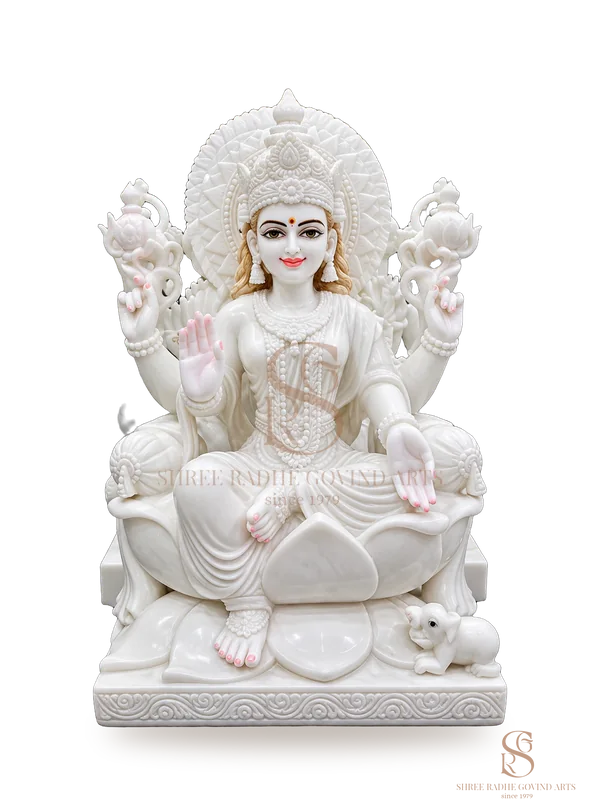
- Lakshmi Maa on Lotus: seated on a full lotus, one hand in blessing and lotuses in her raised hands, with her owl at the base.
- Ganesh ji on Lotus: chaturbhuj Ganesh ji seated on a full lotus, with Mooshak at his feet.
- Ganesh ji on Singhasan: seated on a carved singhasan, one hand raised in blessing. A good choice for larger mandirs and shops.
- Ganesh ji with Prabhavali: seated before a carved prabhavali of leaves and flowers, for a grander look.
If your family also worships Saraswati Maa on Diwali, our Saraswati Maa can be carved to match the pair. Browse all forms in Devi Maa moortis and Ganesh ji moortis.
Looking for a Lakshmi Ganesh pair for this Diwali? Tell us your mandir size and city on WhatsApp. We will share photos of finished pairs and a price the same day.
Ask on WhatsAppWhite, painted or gold work
For Diwali, many families like a little colour and gold. There are three common finishes:
- White with painted features: pure white marble with the eyes and tilak painted by hand. Calm and timeless.
- Painted: soft colours on the vastra, lotus and jewellery.
- Gold work: gold leaf on the crowns and jewellery, which glows beautifully in diya light.
Whichever you choose, keep it the same on both moortis. To understand how finish affects price, see our marble moorti price guide.
Placing the moortis for Diwali puja
Placement customs differ between regions and families. Some keep Ganesh ji on one side of Lakshmi Maa, others on the other, and some place Saraswati Maa or a kalash with them. The best guide is your family tradition and your pandit ji. A few practical points apply to every home:
- Place the moortis on a clean, raised platform or chowki covered with a fresh cloth, never directly on the floor.
- Keep the faces at or slightly above your eye level when you sit for puja.
- Leave space in front for diyas, flowers and prasad, and keep flames a safe distance from painted areas.
- Make sure both moortis stand firm and level. Marble is heavy, so a wobbly surface is a risk.
Our moortis are finished to traditional proportions, so your pandit ji can perform pran pratishtha when they arrive.
Will it reach you before Diwali?
Timing matters most in festival season. Here is how it usually works with us:
- Finished moortis from our showroom usually ship in 3 to 5 days. Delivery time after that depends on your city.
- Custom moortis, carved to your size or photo, usually take 3 to 6 weeks, so they will not be ready for this Diwali. They are a good plan for a griha pravesh, a temple occasion or next year's Diwali.
If you are in Jaipur, the quickest way is to visit our two shops in Chandpol Bazar, open every day from 10 am to 8 pm, and choose a pair in person. For orders from other cities or abroad, read how to buy a marble moorti from Jaipur online. Every moorti is packed in a wooden crate with foam lining and shipped insured.
After Diwali: caring for the moortis
Diwali puja often leaves kumkum, haldi, ghee and wax near the moortis. Wipe them gently with a soft, dry cotton cloth. If you do abhishek, rinse with clean water afterwards and dry fully. Avoid lemon, vinegar, soap and chemical cleaners, which can dull or stain marble, and keep kumkum away from painted eyes. With this simple care, your Lakshmi Ganesh pair will look just as bright at next year's Diwali.
Questions families ask
Which size Lakshmi Ganesh marble moorti is best for a home mandir?
For most home mandirs and pooja rooms, a pair around 12 inch works well. Smaller wall mandirs suit 9 to 12 inch, and large pooja halls or shops can take 18 to 24 inch. Measure the height and width of your mandir and leave room above the crowns and between the two moortis.
Should Lakshmi and Ganesh moortis be bought as a pair?
It is best to choose them together, from the same marble and with the same finish, so they look balanced side by side. Ordering both from one workshop makes matching much easier.
Where should Ganesh ji be placed next to Lakshmi Maa?
Customs differ between families and regions, so follow your family tradition and your pandit ji's guidance. Practically, place both on a clean raised chowki, with the faces at or just above eye level when you sit for puja.
Can I get a marble Lakshmi Ganesh moorti in time for Diwali?
Finished moortis from our showroom usually ship in 3 to 5 days, and delivery time then depends on your city. Custom moortis take 3 to 6 weeks, so for Diwali a finished pair is the safe choice. Ask on WhatsApp and we will tell you honestly what can reach you in time.
Do you ship Lakshmi Ganesh moortis outside India?
Yes. We deliver across India and ship overseas. Every moorti is packed in a wooden crate with foam lining and sent insured.
Looking for a moorti?
Tell us the deity and size. We share photos and an exact price the same day.